
7 Benefits of Customized Security Plans for Your Property
Last Updated: October 22, 2026
Quick Summary
Customized security plans protect a property by matching patrols, lighting, access control, and technology to its actual risks, layout, and operating hours instead of a generic package. This site-specific approach strengthens deterrence, protects the assets that would hurt most to lose, and speeds up emergency response. The result is lower risk exposure, documented incidents, and coverage that moves as your property changes.
- A standard package protects against the average threat, and no property is average.
- Build an asset register before buying anything: list high-value items, storage, access, and loss cost.
- A workable response sequence has five steps, from detect and confirm to review and close.
- Run a tabletop drill once a year with the property manager, on-site lead, and monitoring provider.
- Track incident counts, response times, false alarm rate, and patrol reporting quarterly.
Table of Contents
- Why Customized Security Plans Beat Off-the-Shelf Packages
- Benefit 1: Stronger Crime Prevention and Deterrence
- Benefit 2: Asset Protection and Reduced Risk Exposure
- Benefit 3: Better Emergency Response and Breach Handling
- How a Security Risk Assessment Checklist Shapes Your Plan
- Integrating Technology With Security Personnel for Full Coverage
- Business Security Guard Service Costs and Return on Investment
- Measuring Plan Effectiveness and Keeping It Current
- Frequently Asked Questions
Why Customized Security Plans Beat Off-the-Shelf Packages
A customized security plan is a site-specific protection strategy built around one property's actual risks, layout, and operating hours rather than a generic package sold to every client.
The difference shows up fast. A gated community worries about after-hours vehicle access and gatehouse screening. A distribution center worries about trailer yards and loading docks. A school worries about visitor management and campus access control. One template cannot serve all three.
Below, we break down seven benefits of customized security plans and show exactly how to build one. But first, here is what most guides get wrong: they treat security as a product you buy instead of a risk assessment you act on.
Benefit 1: Stronger Crime Prevention and Deterrence
Deterrence works when a would-be offender sees visible, unpredictable coverage. Tailored security systems place patrols, lighting, and access control where your property is genuinely exposed, not where a generic package happens to put them.
Crime prevention improves when three things line up:
- Visible presence at the entry points criminals actually use
- Unpredictable timing so patterns cannot be studied and exploited
- Fast reporting so a suspicious sighting becomes a documented incident
A common mistake is assuming more guards always means more deterrence. In practice, a smaller team deployed against your real vulnerabilities beats a larger team walking a route that ignores them. Burglary prevention starts with knowing where your property is soft, then making those spots hard.
Benefit 2: Asset Protection and Reduced Risk Exposure
Asset protection is the measurable outcome of matching security measures to what you actually own and where it sits.
The mistake most property managers make is treating "assets" as a single category. In practice, asset loss plays out very differently by property type, and each demands a different response:
- Industrial and warehouse sites lose copper wiring, tools, fuel, and catalytic converters to organized theft crews who scout a yard for weeks before striking. The countermeasure is layered perimeter control: locked gates, motion-activated lighting on the trailer yard, and patrols timed to the hours when crews actually work.
- Hotels and hospitality properties lose guest property, vehicles, and, more expensively, their reputation after a single bad night. The countermeasure is access control at guest floors, camera coverage of parking and back-of-house corridors, and staff trained to log and escalate guest concerns.
- Office buildings lose laptops, tenant files, and, over time, lease renewals when tenants feel unsafe. The countermeasure is visitor management at the lobby, badge-controlled elevator access, and documented patrols that tenants can see.
- Retail sites lose merchandise to shoplifting and organized retail crime, plus cash and fixtures after hours. The countermeasure is a mix of visible deterrence, camera coverage at high-theft aisles, and after-hours alarm verification.
- Multi-site organizations lose the ability to see patterns across locations. The countermeasure is a standardized incident-reporting format so a break-in pattern at one site triggers a review at the others.
Risk mitigation here is not abstract. When you reduce risk exposure, you also reduce liability exposure. Documented patrols, working cameras, and clear incident logs give your insurer and your attorney something concrete to point to after a claim.
The practical takeaway is to build an asset register before you buy anything: list every high-value item, where it is stored, who has access, and what a loss would cost in dollars and downtime.
Benefit 3: Better Emergency Response and Breach Handling
Emergency response speed depends less on how fast someone can run and more on how fast the right person is notified.
A workable response sequence has five steps, and every person on site should be able to recite them:
- Detect and confirm. A sensor, camera, or person flags activity. A guard or monitoring center confirms whether it is real before escalation.
- Notify in order. The plan lists who is called first, second, and third, typically the on-site lead, then the property manager, then law enforcement, with phone numbers and backup contacts.
- Respond on site. A trained person follows a site-specific protocol: secure the area, preserve the scene, and avoid contaminating evidence.
- Document in real time. The timeline, actions taken, and outcome are recorded as they happen, not reconstructed from memory the next day.
- Review and close. The incident report goes to the property manager and, where relevant, the insurer, with a note on what the plan should change.
Different breach types need different playbooks. A forced door at 2 a.m. calls for perimeter containment and a law enforcement notification. A trespasser in a parking garage calls for a verbal challenge and a documented escort off the property.
What most guides miss is the paperwork side. A fast response that produces no incident report is nearly useless afterward. You need the timeline, the actions taken, and the outcome recorded, because that record protects you in disputes, insurance claims, and tenant conversations.
Finally, test the plan before you need it. Run a tabletop drill once a year with the property manager, the on-site lead, and the monitoring provider, and walk through one scenario per property type. A plan that has never been rehearsed is a document, not a capability.
How a Security Risk Assessment Checklist Shapes Your Plan
A security risk assessment checklist is the tool that turns a vague worry into a documented, prioritized plan. Run it before you buy anything.
Use these items as your starting checklist:
- Map every entry and exit point, including service doors and gates
- List operating hours, including after-hours access protocols
- Identify high-value assets and where they are stored
- Review lighting, fencing, and sightlines at night
- Document current camera, alarm, and access control coverage
- Note past incidents, even minor ones, with dates
- Review tenant or occupant concerns and complaints
- Confirm who responds and how fast during off-hours
- Check cybersecurity around connected cameras and access systems
The Cybersecurity and Infrastructure Security Agency's physical security guidance is a useful free reference for structuring the physical side of this assessment. Score each item by likelihood and impact, then fund the highest scores first. That scoring is what makes the plan customized rather than copied.
Integrating Technology With Security Personnel for Full Coverage
Technology and people cover each other's blind spots. Cameras record everything and notice nothing. Guards notice everything and cannot watch 40 screens at once. Put them together and you get monitoring and accountability that neither delivers alone.
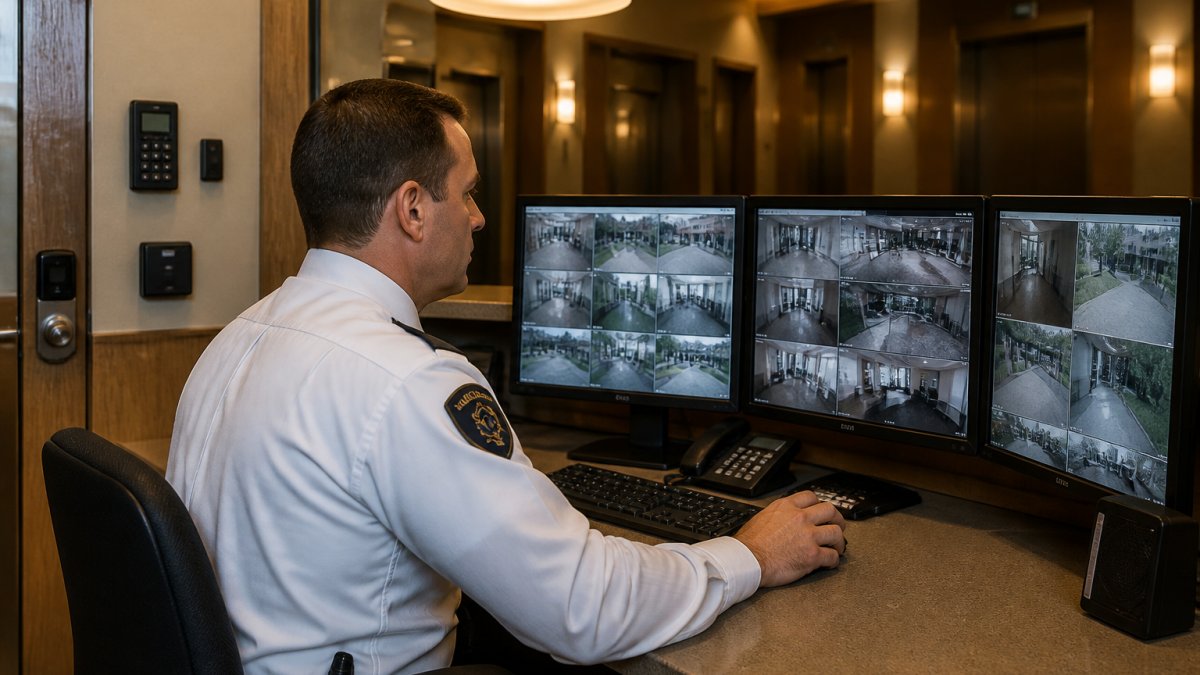
The practical setup looks like this:
- Video monitoring flags activity at gates and docks, and a guard responds
- Access control logs every badge swipe, and patrols verify the doors match the log
- Alarm systems trigger a dispatch, and a guard confirms on site before law enforcement is called
This last point matters. False alarms erode police response over time, and many departments now prioritize verified alarms. A guard who confirms a real breach before calling improves response time and keeps your relationship with local law enforcement healthy. Security integration is not about buying more devices.
Business Security Guard Service Costs and Return on Investment
Business security guard service costs depend on coverage hours, the number of posts, required training, and whether you need mobile patrol or a fixed gatehouse. No honest provider quotes a number before understanding your site.
What we can tell you is how to think about return on investment. Frame the spend against what a loss would actually cost you:
| Cost Category | What Drives It | How to Control It |
|---|---|---|
| Coverage hours | Shifts per day, 24/7 vs. after-hours | Match hours to real risk windows |
| Number of posts | Entrances, gates, sensitive areas | Consolidate access points |
| Training level | Site-specific vs. general | Invest where turnover risk is highest |
| Technology | Cameras, access control, alarms | Phase in, prioritize high-risk zones |
| Management | Reporting, supervision, accountability | Demand documented oversight |
The return shows up as avoided asset loss, fewer incidents, lower liability exposure, and steadier business operations. For a property manager, the strongest argument is often continuity: a tenant who feels safe renews the lease. We recommend building your budget around your assessed risks, then scaling coverage as the plan proves itself. For current pricing on a tailored program, reach out to Sarasota Security Patrol for a quote.
Measuring Plan Effectiveness and Keeping It Current
A security plan is a living document, not a binder that goes on a shelf. Measure it, then update it.
Track these indicators quarterly:
- Incident counts and types, compared to the prior period
- Response times from alarm or sighting to on-site confirmation
- False alarm rate, which signals sensor or protocol problems
- Patrol completion and reporting consistency
- Tenant or occupant feedback on how safe the property feels
The FBI's Uniform Crime Reporting program publishes local crime data you can use as an outside benchmark for your area, which helps you spot trends your own logs might miss.
Review the plan whenever something changes: a new tenant, a remodel, a shift in operating hours, or a fresh incident pattern. Security vulnerabilities move as your property changes. The plan has to move with them.
Every property carries risk, and the only question is whether your coverage matches it. Generic packages leave gaps you cannot see until something goes wrong.
Frequently Asked Questions
How does a customized security plan differ from a standard security package?
A standard package applies the same coverage to every property: fixed patrol times, generic camera placement, and one response protocol. Customized security plans start with a security assessment of your specific site, then build measures around your layout, hours, occupancy, and assets. That means patrol routes matched to your vulnerable zones, access control tied to your actual entry points, and response procedures written for your team. The result is site-specific protection instead of coverage that fits no one perfectly.
Can a customized security plan help reduce business insurance premiums?
It can contribute. Insurers look at documented risk mitigation when setting premiums, and a plan that includes monitored alarms, access control, and recorded patrol activity gives underwriters evidence of reduced risk exposure. Many carriers offer insurance discounts for verified security measures, but the amount varies by policy and provider. Ask your insurer which specific measures they credit, then have your security provider document them. The premium savings are real for some properties, and the larger financial benefit usually comes from avoided asset loss and liability claims.
What should a security risk assessment checklist cover?
A working checklist covers perimeter and entry points, lighting and sightlines, camera coverage and blind spots, access control for staff and visitors, after-hours procedures, alarm response times, and past incident history. Add asset inventory for high-value equipment, employee and tenant concerns, and coordination with local law enforcement. Walk the property at different hours, because vulnerabilities look different at 2 p.m. and 2 a.m. Review the checklist at least annually and after any security breach or major layout change.
How do customized security plans improve response times during incidents?
Response time depends on how fast someone detects a problem and how clearly the next steps are defined. A tailored plan sets specific triggers for alarms, assigns who contacts law enforcement, and maps the fastest route for patrols to the affected zone. Personnel trained on your site skip the orientation delay that comes with generic coverage. Regular drills and monitoring and accountability checks keep those times sharp. The practical gain is minutes, and in a burglary or medical emergency, minutes decide the outcome.

