
Top-Rated Florida Security Guard Services With Custom Plans
Last Updated: October 23, 2026
Quick Summary
Top-rated Florida security guard services offering customized protection plans start with a documented risk assessment, then build written post orders, patrol routes, and reporting around your site. Sarasota Security Patrol has delivered that kind of customized security since 1962, combining armed and unarmed guards, mobile patrol, and local management.
- A custom protection plan should begin with a documented risk assessment before any proposal.
- Most properties need unarmed guards; armed coverage should be limited to specific higher-risk posts.
- 24/7 coverage costs roughly three times an 8-hour weekday post for the same location.
- Verify the agency license and individual guard credentials with the state before signing.
- Confirm general liability and workers' compensation insurance via a certificate of insurance.
Table of Contents
- What Top-Rated Florida Security Guard Services Offer in 2026
- How a Security Risk Assessment Shapes a Custom Protection Plan
- Armed and Unarmed Security Guards: Matching Coverage to Your Risk
- What Drives Security Guard Service Cost in Florida
- Coverage Types: Residential, Commercial, Mobile Patrol, and Event Security
- How to Choose a Security Company: Licensing, Insurance, and Contract Terms
- Comparing Top-Rated Florida Security Guard Providers Side by Side
- Conclusion
- Frequently Asked Questions
What Top-Rated Florida Security Guard Services Offer in 2026
Finding top-rated Florida security guard services that offer customized protection plans starts with knowing what separates a real security partner from a warm body in a uniform. The best providers build a written security program around your site, your schedule, and your actual risks, then staff it with trained, licensed guards and back it with supervision you can verify.
Sarasota Security Patrol has delivered that kind of customized security since 1962. The difference matters most after hours, when nobody from your team is on site to catch a gap.
Here's what the strongest providers consistently offer in 2026:
- A documented risk assessment before any proposal
- Armed and unarmed guard options matched to the site
- Mobile patrol and on-site coverage that can flex by shift or season
- Access control and visitor management support at gates and lobbies
- Written post orders, supervision visits, and reporting you can audit
Below, we break down how custom plans are built, what drives cost, and how to compare providers side by side without relying on marketing claims.
How a Security Risk Assessment Shapes a Custom Protection Plan
A security risk assessment is a structured review of your property, operations, and history that identifies where you're exposed and what coverage closes the gap. It comes first because a custom protection plan built without one is just a guess with a monthly invoice attached.
A common mistake is treating the assessment as a sales formality. In practice, this is where the real customization happens. A property manager with after-hours tenant access protocols needs different post orders than a logistics yard guarding equipment overnight.
A useful assessment covers:
- Site walk: entrances, lighting, parking, loading areas, and blind spots
- Access points: who enters, when, and how entry is logged
- Incident history: prior theft, vandalism, trespassing, or disturbances
- Coverage gaps: hours, days, or zones with no eyes on them
- Response expectations: what a guard should do, and who they call, in each scenario
The output is a written security plan: post orders, patrol routes, reporting cadence, and escalation steps. Ask to see a sample before you sign. If a provider can't show you how their plan differs from the last client's, the customization is marketing, not method.
Armed and Unarmed Security Guards: Matching Coverage to Your Risk
Most properties need unarmed guards, and the ones that need armed coverage usually need it in specific posts, not across the whole site. Getting that match right controls both risk and cost.
Unarmed guards handle observation, access control, visitor management, patrols, and reporting. They're the right fit for office buildings, HOAs, gated communities, schools, and most retail environments.
The practical question isn't which sounds safer. It's which post actually justifies armed coverage. A guard company that recommends armed officers for every post is selling, not assessing.
Licensing matters here too. Florida regulates security officers and agencies through the Florida Department of Agriculture and Consumer Services licensing division, which maintains the state's licensing framework for security officers and agencies.
What Drives Security Guard Service Cost in Florida
Pricing for security guard services depends on coverage hours, guard type, site complexity, and contract structure, not a single flat rate. We don't publish rate cards because two buildings on the same street can need very different programs, and a quote built without a site walk is a number, not a plan.
Common pricing models. Most providers quote one of three ways: a straight hourly bill rate per post, a monthly program fee that bundles supervision and reporting, or a hybrid with a base fee plus hourly overage for extra shifts. Ask which model a provider uses before comparing numbers, because an hourly rate and a monthly program fee are not the same unit of measure.
What typically moves the bill. In most markets, unarmed guard posts price lower per hour than armed posts, and 24/7 coverage costs roughly three times an 8-hour weekday post for the same location. Site complexity adds cost when a property needs multiple entrances staffed, long patrol routes, or gatehouse coverage around the clock. Technology such as access control integration, camera monitoring, and electronic reporting adds equipment and monitoring cost. Contract term matters too: month-to-month arrangements usually carry a higher rate than annual agreements, but they preserve flexibility if your needs change.
| Cost Driver | What Changes It | Effect on Price |
|---|---|---|
| Coverage hours | 8-hour post vs. 24/7 coverage | More hours, higher cost |
| Guard type | Unarmed vs. armed posts | Armed posts cost more |
| Site complexity | Multiple entrances, gates, patrol zones | More posts or longer routes |
| Technology | Access control, cameras, reporting systems | Equipment and monitoring add cost |
| Contract term | Month-to-month vs. annual | Term affects rate and flexibility |
| Supervision | Frequency of site visits and audits | More oversight, higher cost |
How to read a quote. A useful quote separates labor, supervision, uniforms and equipment, and any technology fees so you can see what you are actually buying. A common mistake is comparing hourly rates across providers without comparing what's included. One quote may bundle supervision, reporting, and uniforms; another may bill them separately.
Questions that surface the real cost. Ask each provider: What is the bill rate for unarmed and armed posts? Is supervision included or billed separately? What happens to the rate if I add a second shift or reduce coverage seasonally? What is the call-off and replacement policy, and is there a charge for uncovered shifts? The answers tell you more about total cost than any single number.
Coverage Types: Residential, Commercial, Mobile Patrol, and Event Security
Customized protection plans usually combine several coverage types rather than relying on one. The right mix depends on what you're protecting and when it's most exposed.
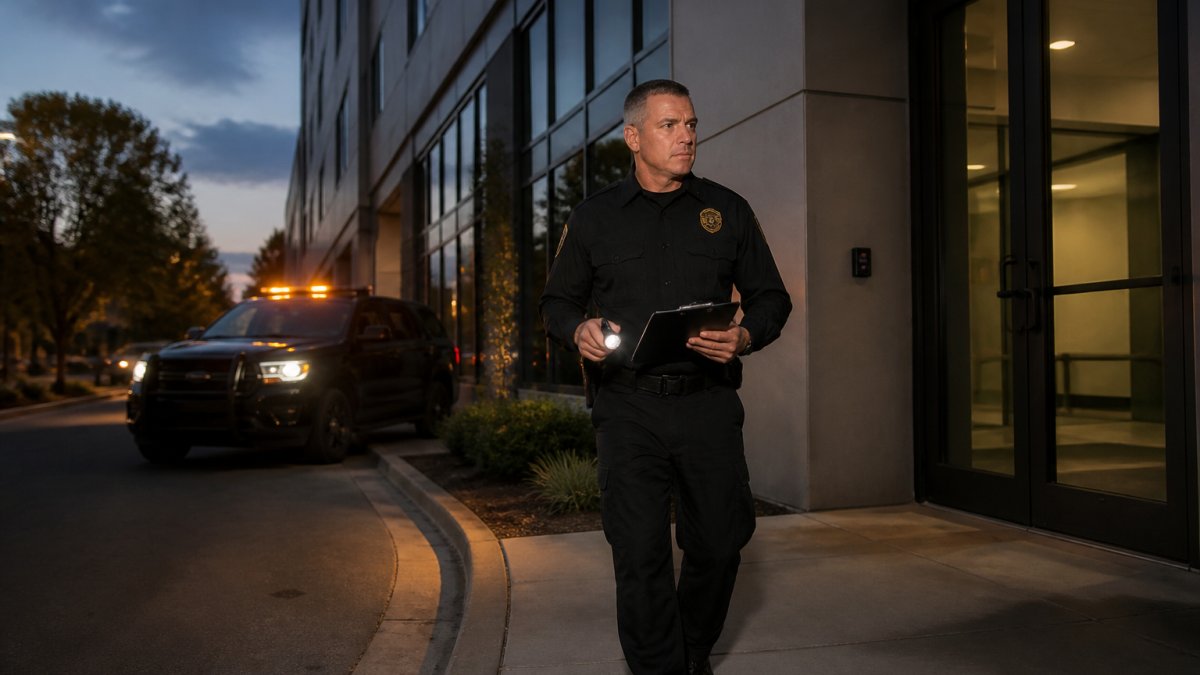
Residential security covers HOAs, gated communities, and condo associations: gatehouse staffing, visitor management, and overnight patrols.
Commercial security covers office buildings, retail, industrial sites, and medical facilities: lobby coverage, access control, tenant relations, and asset protection.
Mobile patrol sends a marked vehicle through a property on a set schedule, checking doors, gates, and lots.
Event security adds crowd management, entry screening, and parking control for a defined window. It's staffing-intensive and needs a plan built around the venue and expected attendance.
Most clients end up with a blend, such as gatehouse coverage plus overnight mobile patrol. The plan should say exactly which coverage applies to which hours.
How to Choose a Security Company: Licensing, Insurance, and Contract Terms
Choosing a security company comes down to three checks: verified licensing, adequate insurance, and contract terms you can live with. Get all three in writing before you commit.
Licensing. Confirm the agency holds a current state license and that assigned guards are licensed and trained. Ask for license numbers and verify them with the state rather than accepting a certificate copy.
Insurance. Request a certificate of insurance showing general liability and workers' compensation coverage, and confirm you're named appropriately. A provider that hesitates on this is a provider to skip.
Contract terms. Read the termination clause first. You want clear notice terms, defined service levels, and a straightforward process for removing a guard who isn't working out. Long lock-ins with no performance remedy protect the provider, not you.
Use this checklist before signing:
- Agency license verified with the state
- Individual guard credentials confirmed
- Certificate of insurance received and reviewed
- Written post orders specific to your site
- Supervision frequency stated in the contract
- Reporting cadence and format defined
- Termination notice period and process clear
- References from comparable properties contacted
Comparing Top-Rated Florida Security Guard Providers Side by Side
Comparing providers on the same criteria is the fastest way to see who actually customizes and who just rebrands a standard package. Ratings and reviews help, but the evaluation criteria matter more than the star average.
How to judge top-rated status. Look for verifiable signals rather than marketing claims: a current state agency license, documented guard training, published supervision and reporting practices, and references from properties comparable to yours.
| Evaluation Criteria | What to Look For | Why It Matters |
|---|---|---|
| Custom plan process | Documented risk assessment before proposal | Shows real customization |
| Licensing and training | Verifiable state licenses, ongoing training | Reduces liability and gaps |
| Coverage range | On-site, mobile patrol, event, access control | One provider for multiple needs |
| Supervision | Scheduled site visits and audits | Guards stay accountable |
| Reporting | Written reports you can review | Evidence of service quality |
| Transition process | Defined onboarding and handoff plan | Avoids coverage gaps |
| Contract flexibility | Clear notice and guard replacement terms | Protects you if it isn't working |
| Local management | Decision-makers you can reach | Faster response to issues |
How to run the comparison. Score each provider on the criteria above and weight them for your property. A hospital and an HOA will rank these differently.
This is where Sarasota Security Patrol stands out. We've operated since 1962, and our approach starts with immersing in your organization's culture and mission. Our transition process is built to be efficient and transparent.
Conclusion
The hardest part of hiring security isn't finding a provider.
If you're evaluating Florida security guard services and want a partner who builds the plan around your property, Sarasota Security Patrol has done exactly that since 1962. Our customized security solutions, efficient transition process, and local management are designed to make the coverage reliable. Call us to request a consultation and see what a plan built for your site actually looks like.
Frequently Asked Questions
What should a customized security protection plan include?
A customized plan starts with a security risk assessment of your property, then sets guard staffing levels, post orders, patrol routes, and access control procedures. It should specify whether armed or unarmed guards fit the site, response protocols for incidents, and reporting requirements. Ask for the plan in writing and confirm it covers your after-hours access rules and tenant or resident concerns. A provider that builds the plan around your site, not a template, is a good choice.
How do I compare security guard companies in Florida?
Check Florida licensing and insurance first, then compare how each provider develops custom protection plans. Ask for references from property managers with similar sites, review contract length and cancellation terms, and confirm guard training and accountability systems. Request a security consultation and a written scope before signing. Side-by-side comparison of coverage, response capability, and reporting helps evaluate service quality.
How can I verify a security company's licensing and insurance?
Florida requires security guard companies and individual guards to hold state licenses, and providers should carry liability insurance. Ask for license numbers and certificates of insurance, then verify them with the state licensing authority. Confirm that guards assigned to your site are licensed and trained, and ask how the company documents accountability, such as patrol logs or check-in systems. A reputable provider shares this information without hesitation.
What questions should I ask before hiring a security guard service?
Ask how the company customizes plans for properties your size, how long integration takes, and what happens if a guard does not work out. Request references from similar clients and ask about contract flexibility. Confirm guard training, supervision, and reporting. Also ask what a security risk assessment includes and whether pricing reflects site-specific factors. Clear answers to these questions help assess a provider's capabilities.


